
The IC memo problem is review
IC memos and credit memos are now often drafted with tools, and senior review adds days. What the surveys measured, and what makes a memo quick to review.
Read →A Word template for an IC memo, with private credit and venture annexes, and a 12-page checklist of what a partner should test in each section.
You get the template (Word) and the reviewer's checklist (PDF).
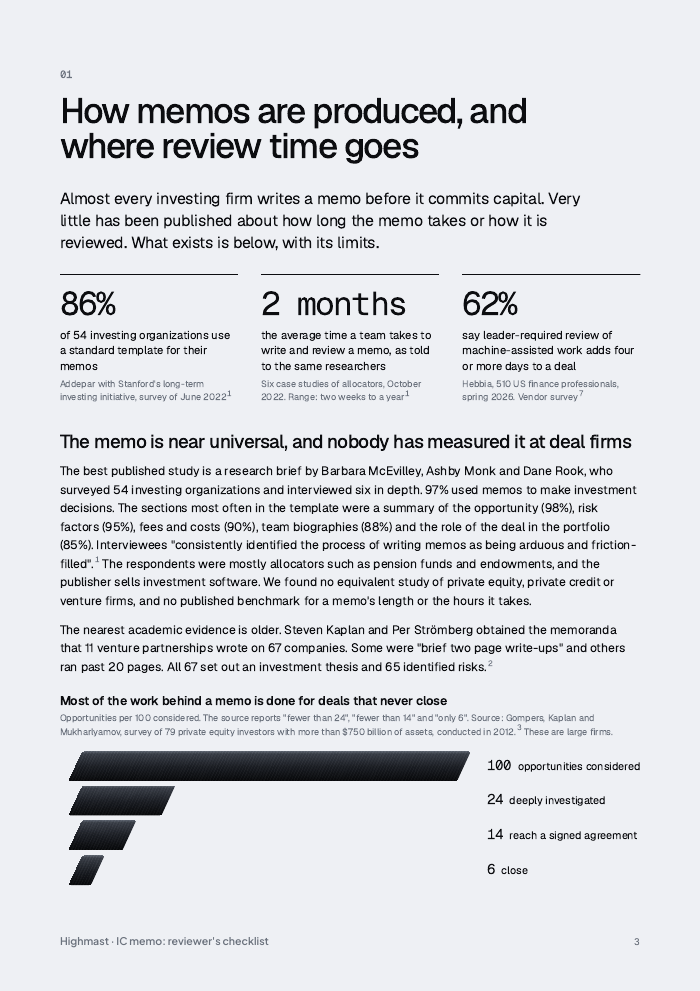
An investment committee memo is drafted once and reviewed several times, and review is where the days go. In Hebbia's 2026 survey of 510 US finance professionals, 40% already use tools to draft IC memos or deal summaries, and 62% say the review their leaders require of that work adds four or more days to a live deal.1 Hebbia sells software for this work, so read the figure as a direction. The cause it names is familiar: the partner cannot see where a number came from, so the partner checks all of them.
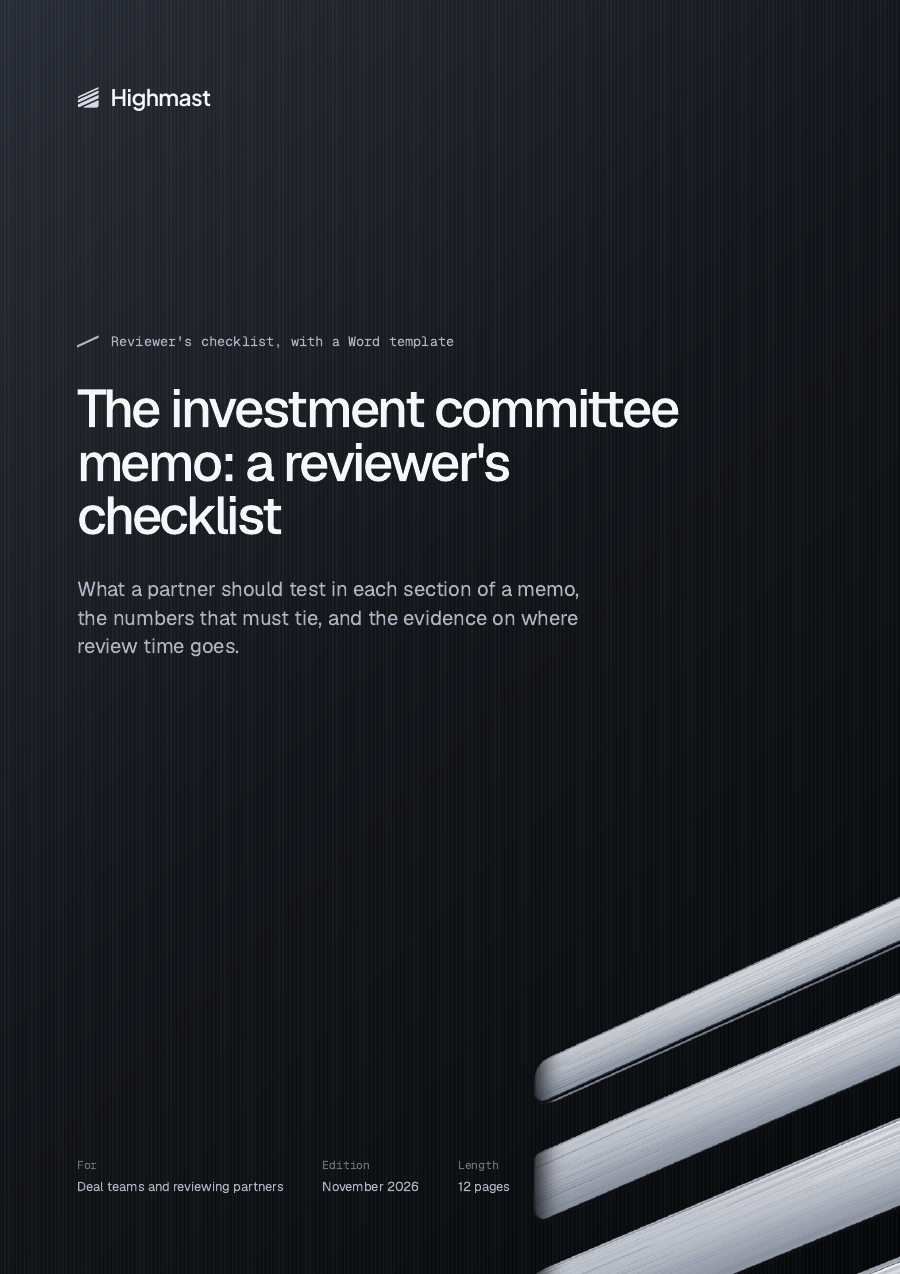
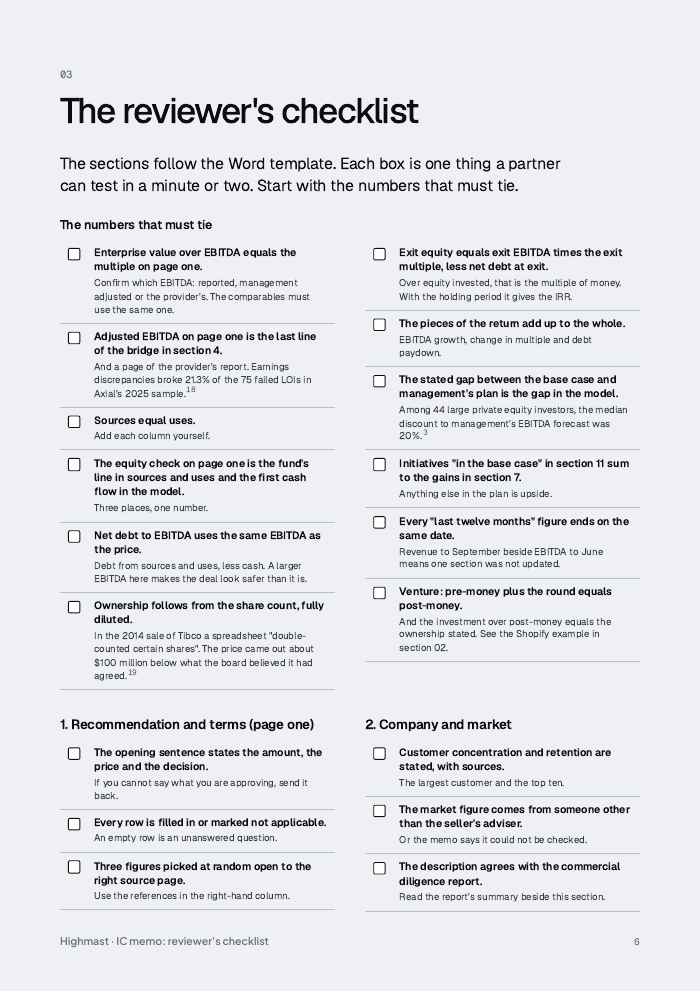
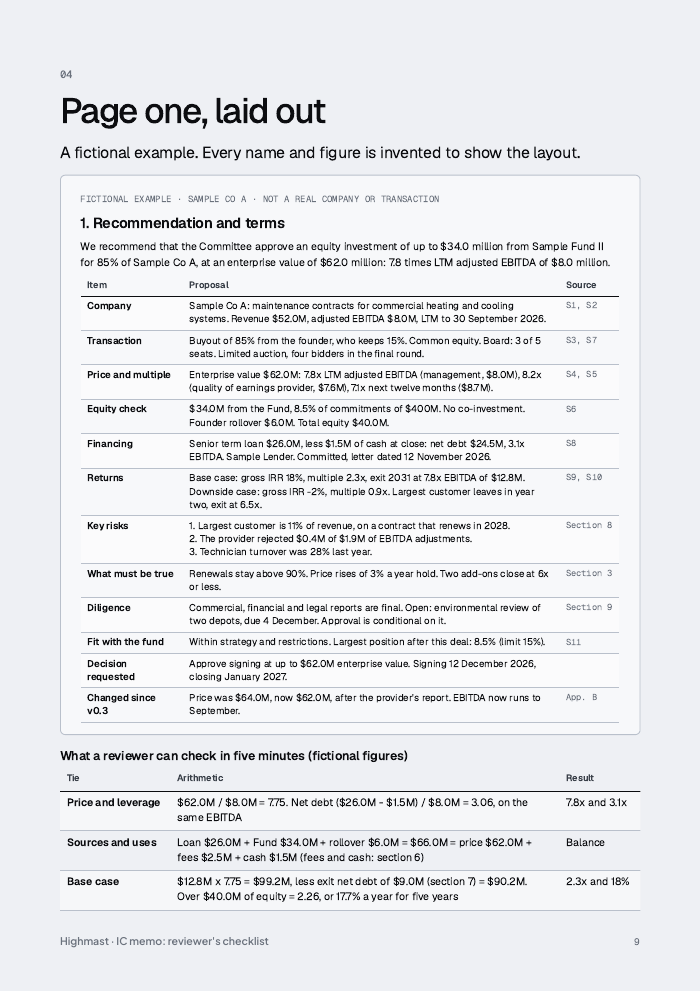
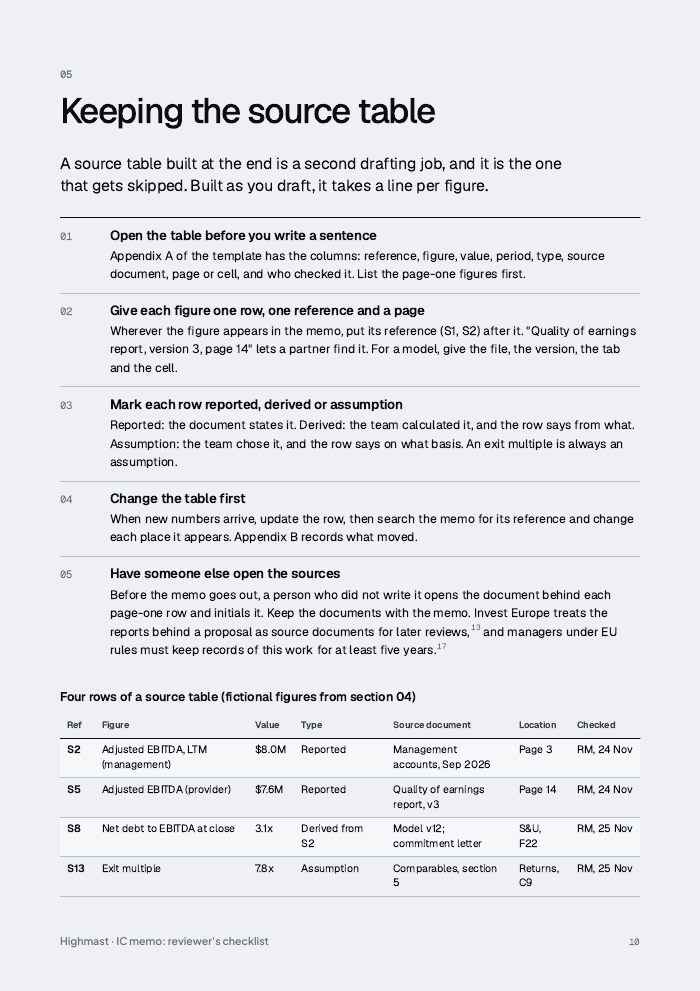
This pack is a memo built to be reviewed. The Word template puts the recommendation and terms on page one, as a table with a row for each question a committee always asks. Every section has a short drafting note, and the memo ends with a source table that ties each figure to a document and a page. Two annexes adapt it for a private credit memo and a venture memo. The 12-page checklist tells the reviewer what to test in each section and lists 12 sets of numbers that must agree.
We compared 15 memos written for real decisions before settling the structure: 12 venture memos published by Bessemer Venture Partners and three 2026 memos to public pension boards in Pennsylvania and New Jersey.2 We read them against Invest Europe's professional standards, the US Small Business Administration's credit memo standard, US guidance on leveraged lending and the academic surveys of private equity, venture and private debt investors.34 The wording is our own. One thing that reading turned up: a well-known published venture memo gives its pre-money valuation as $20 million in one section and $25 million in another.2
It is a template and a checklist. It does not tell you what to invest in, and nothing in it is legal, regulatory or investment advice. We found no published measure of how long a memo takes at a deal firm, so the pack makes no claim about hours saved. For the evidence on review time, read the IC memo problem is review, or see how this job fits private equity and private credit firms.
Yes. Use it inside your firm and change it as you like.
No. Every firm's template differs. The structure is our synthesis of 15 memos written for real decisions, four official standards and three published outlines, all named in the checklist. Change the sections to suit your committee, and keep the order the same from deal to deal.
Yes. Annex 1 replaces seven sections of the main memo with a credit memo's: facility terms, sources and uses, covenants with headroom, the downside case and recovery, the sponsor, and documentation points. Annex 2 does the same for a venture round, with team, traction, round terms, references and what must be true.
We found no published benchmark for deal firms. The venture memos that Kaplan and Strömberg studied ran from two pages to more than 20. The main memo in this template is meant to run 10 to 14 pages before appendices, with the recommendation and terms on one page.
Yes. Fixed sections and a source table suit a tool-drafted first version, because the reviewer can check each figure against a named page and does not have to redo the work. The template is a plain Word file with no macros.
It is a standard .docx file. We built it with a document library and checked it by converting it back to text. We have not opened it by hand in every word processor, and page breaks can differ between them, so tell us if a table misbehaves.
No. It is a drafting aid. Your fund documents, your policies and the rules that apply to your firm decide what a memo must contain and how long it is kept.
IC memos and credit memos are now often drafted with tools, and senior review adds days. What the surveys measured, and what makes a memo quick to review.
Read →
Surveys put AI use in dealmaking anywhere from 21% to 96%. We set 11 studies from 2025 and 2026 side by side and show what each one actually asked.
Read →
What the 2026 surveys and controlled studies measured about wrong numbers in machine-drafted deal documents, and what a reviewer should check and sign.
Read →How many more deals the same team could carry, worked out from your own hours.
Which heavy job to systemise first, ranked from four questions about each.
What the 2026 surveys measured about AI in deal teams, and what they did not.