
1,191 deals in, two closed: the private equity funnel
A lower-market private equity firm logs a median 1,191 deals a year and closes two. What the funnel costs in reading time, and which job to fix first.
Read →Pick the jobs that take your deal team's time, answer four questions about each, and get a ranked list of which to systemise first and which to leave.
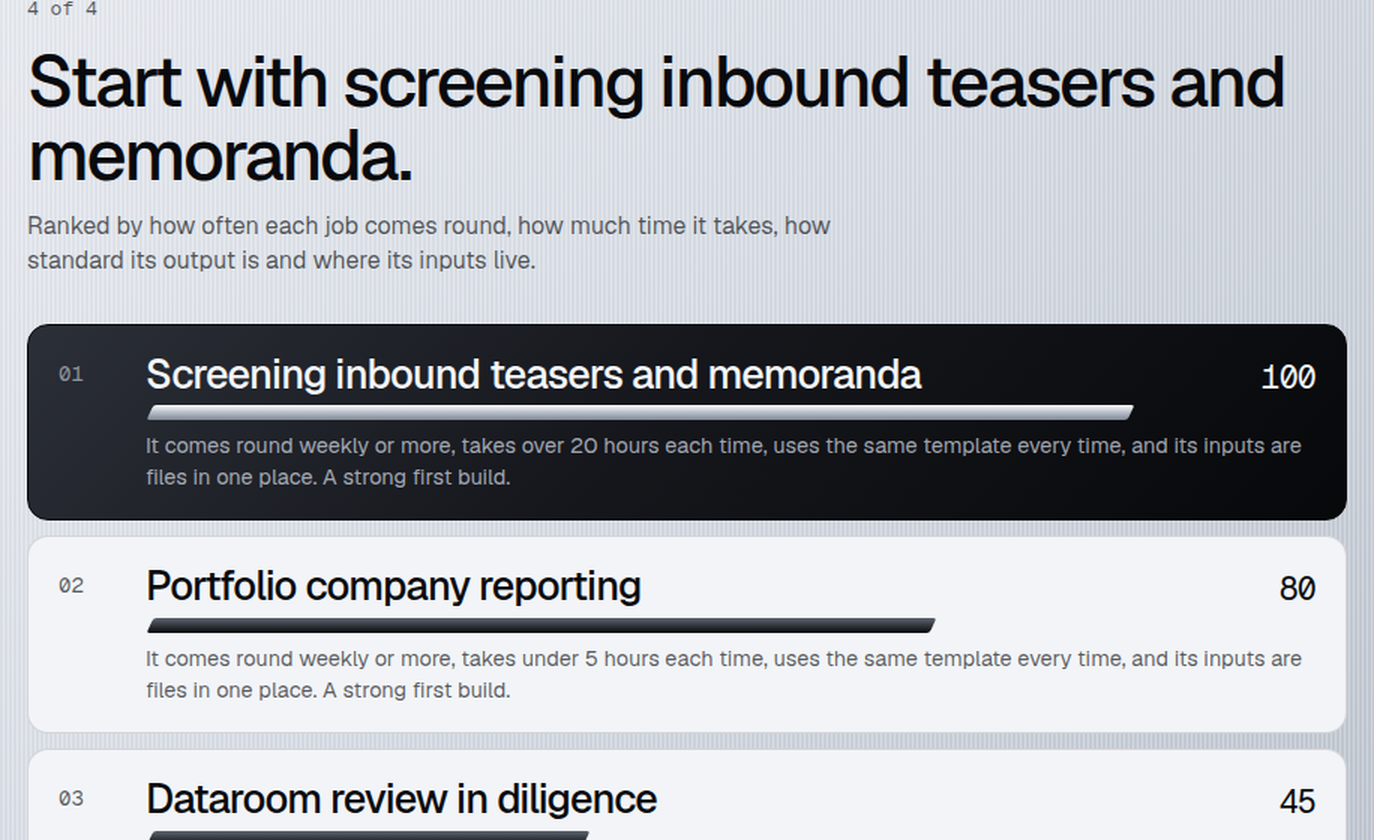
Most firms that try this start with the wrong job. They pick the most visible document, or the one a partner complains about, and find six weeks later that it is produced four times a year from notes nobody wrote down.
The scorecard takes about five minutes. You choose between three and six jobs from a list for your kind of firm, and answer four questions about how each one runs today. The result ranks them and says, for the ones that are not ready, what has to change first.
It is a short version of the map we make in the first two weeks of an engagement. The map measures hours. This asks you to estimate them.
They are the ones that decide whether a first build pays back. A job that runs weekly on a fixed template, from files in one place, can be tuned in a month. A job that runs twice a year from people's inboxes cannot.
Every job on the lists ends in a document a senior person signs, and that review stays whatever is built. The numbers check in our library covers how to do that review quickly.
No. Nothing you enter leaves the page. You can save the result as a PDF.
A lower-market private equity firm logs a median 1,191 deals a year and closes two. What the funnel costs in reading time, and which job to fix first.
Read →
The only measured hours-per-deal figure we found comes from venture capital: 118 hours, 83 days, 10 references. What a small firm should take from it.
Read →
What investors now expect from a quarterly report, where a small fund loses hours and makes errors assembling it, and what to standardize first.
Read →How many more deals the same team could carry, worked out from your own hours.
What the 2026 surveys measured about AI in deal teams, and what they did not.
A sell-side mandate in seven stages: sourced durations, failure rates, an hours worksheet.