Why reviewers still re-check machine output
What the 2026 surveys and controlled studies measured about wrong numbers in machine-drafted deal documents, and what a reviewer should check and sign.
Read →A 30-minute method for reviewing a machine-drafted memo or CIM: which figures to check in full, how many to sample, and when to send it back.
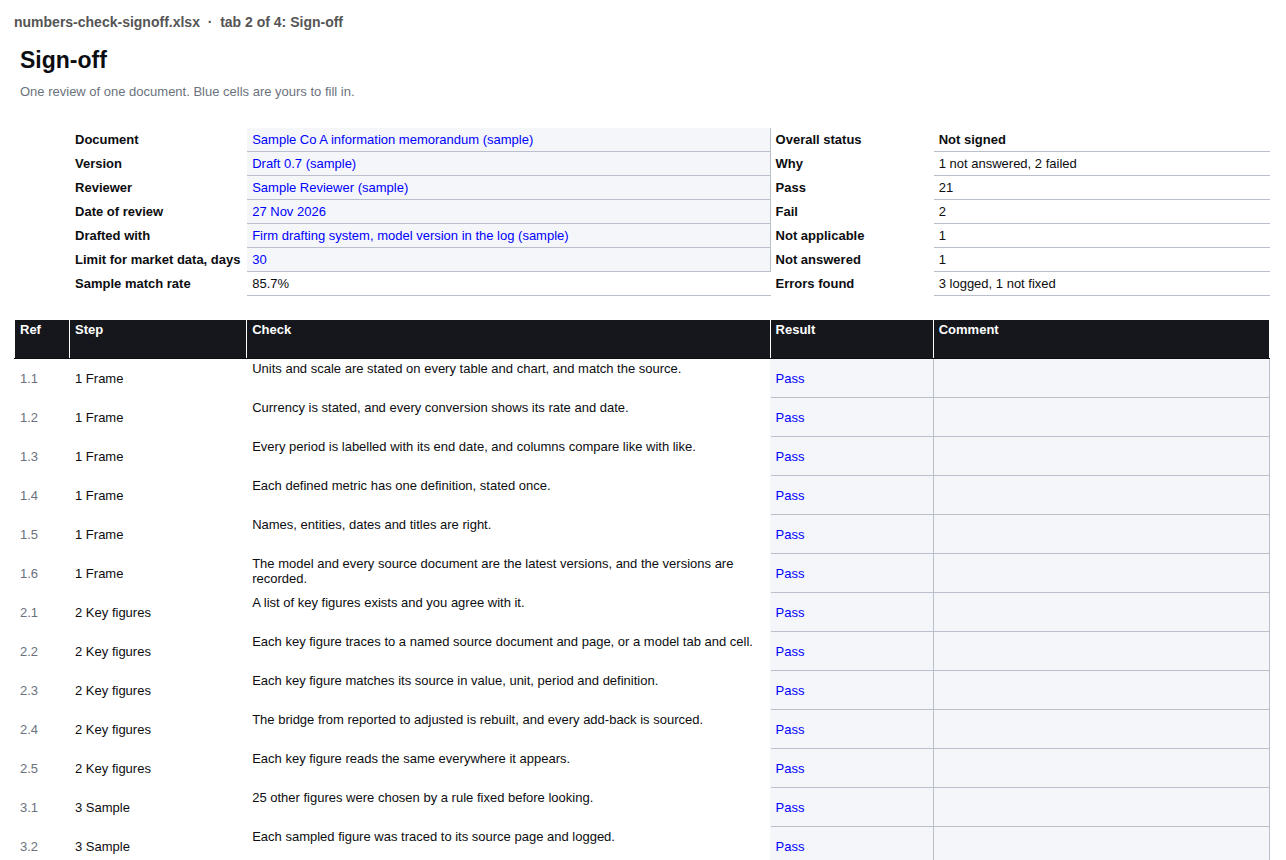
You get the checklist (PDF) and the sign-off sheet (Excel).
People who review deal documents are already re-checking them. In a 2026 survey of 510 US finance professionals, 59% said they verify or re-create machine output by hand all or most of the time.1 In another, 40% of 400 senior deal professionals reported hallucinated output that led to inaccurate diligence in the past 12 months.2 Both surveys were published by vendors. What the re-check should cover is rarely written down.
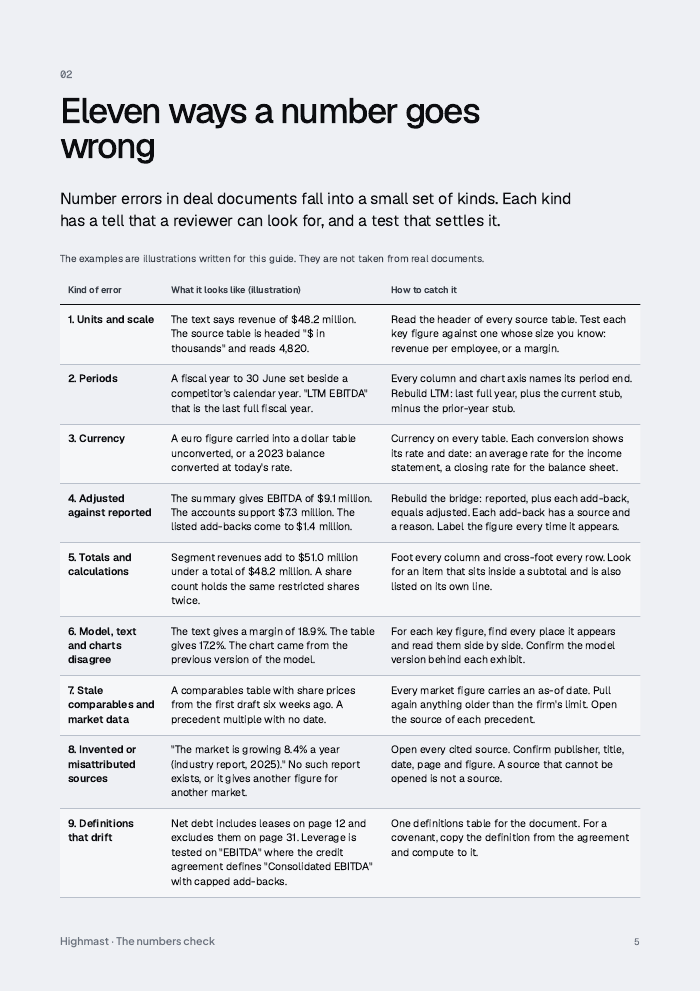
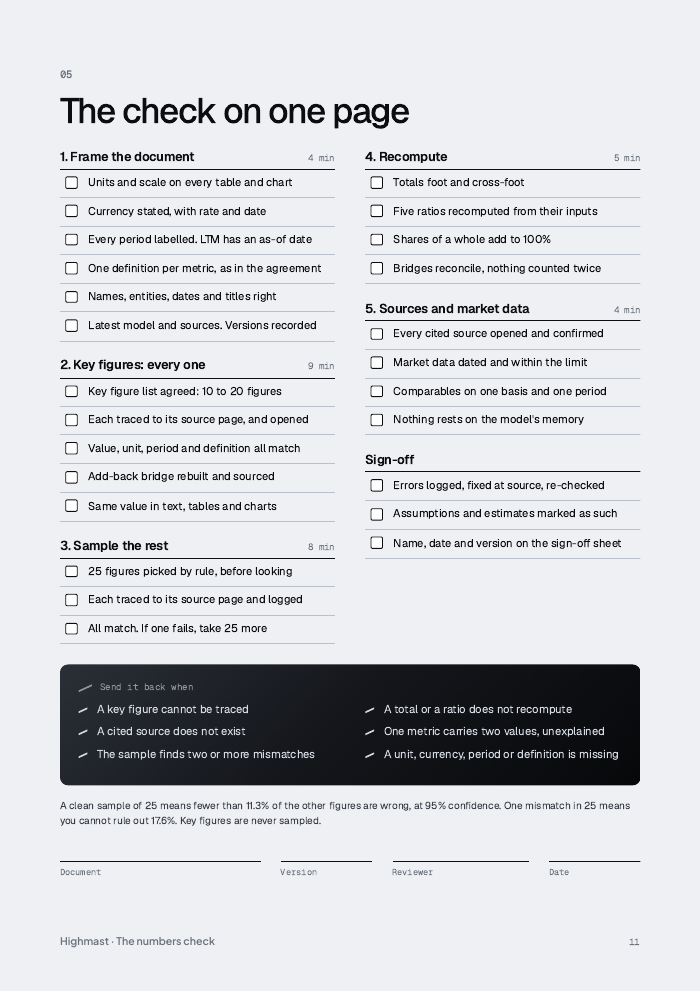
This guide writes it down. It sets out 11 kinds of number error with a test for each, then a check in five steps: frame the document, trace every key figure to its source, sample 25 of the rest by rule, recompute the totals and ratios, and open the cited sources. It says when to send a document back to the drafter. A one-page version is there to pin up, and the workbook keeps a record of each review.
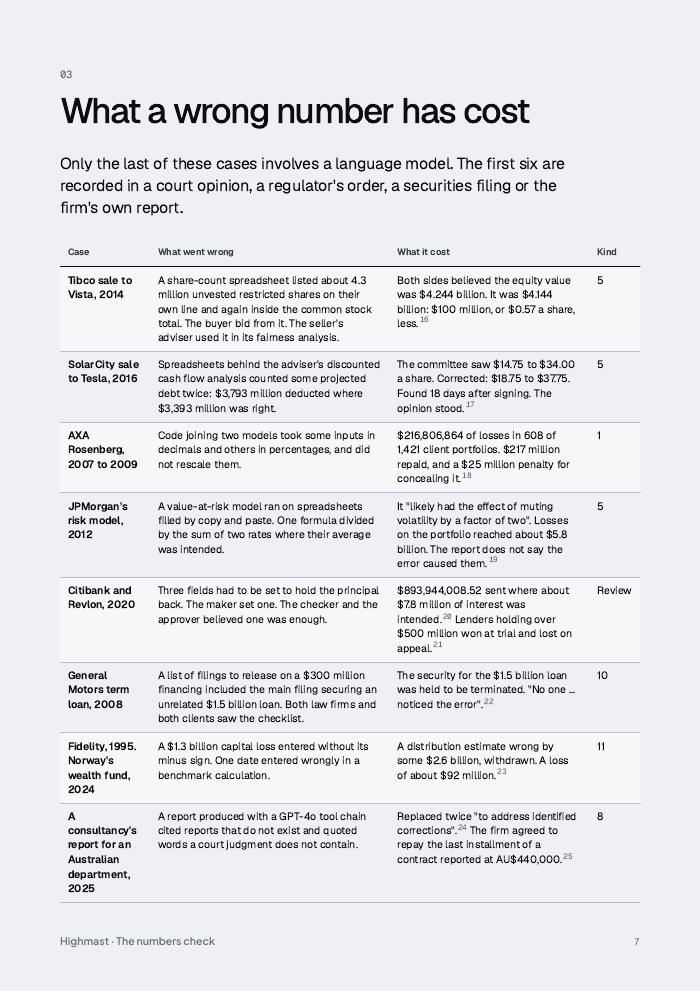
The method follows how errors are recorded as happening. The cases come from court opinions, SEC filings and regulators' orders, among them a share-count spreadsheet that led both sides of a sale to believe the price was $100 million higher than the $4.144 billion in the signed agreement.3 The sampling rule is borrowed from audit practice, and the arithmetic behind it is shown so you can change the sample size. The article Why reviewers still re-check machine output covers the evidence at more length.
It does not judge the argument of a memo, and it is not legal advice. The 30 minutes is our working estimate for a document whose figures carry source pointers. It is not a measurement.
Yes. Use it inside your firm and change it as you like.
About 30 minutes for a 40 to 60 page document whose figures carry source pointers. That is our working estimate, not a measurement. Without pointers, tracing the figures takes several times longer, which is the reason to ask the drafting tool to supply them.
It is a number a reviewer can trace in one sitting, and the arithmetic is plain. If 25 figures chosen by rule are all right, fewer than 11.3% of the rest are wrong, with 95% confidence. One mismatch in 25 means you cannot rule out 17.6%, so the method asks for 25 more.
Yes. Most of the documented cases in the guide are spreadsheet and checklist errors made by people. The check is the same.
No. It covers numbers, sources and definitions. It is general information, not legal advice, and it does not cover disclosure, confidentiality or what a regulator requires of your firm.
What the 2026 surveys and controlled studies measured about wrong numbers in machine-drafted deal documents, and what a reviewer should check and sign.
Read →
How a teaser and an information memorandum are built from the model, the dataroom and management notes, where errors get in, and what a sourced draft shows.
Read →
Most boutique banks cannot say how many more mandates the current team could run. The sourced inputs, the missing one, and the arithmetic on one page.
Read →How many more deals the same team could carry, worked out from your own hours.
Which heavy job to systemise first, ranked from four questions about each.
What the 2026 surveys measured about AI in deal teams, and what they did not.